
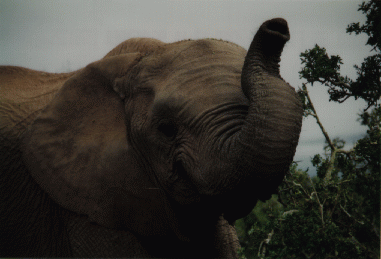
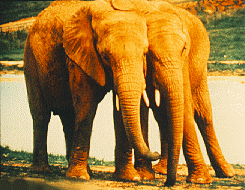
The most distinctive and unusual external feature of the elephant is the flexible, muscular trunk. The trunk is an elongated nose with nostrils at the end as well as one (in the Asian elephant) or two (in the African elephant) fingerlike projections with which the elephant can examine, or even grasp, small objects. Elephants drink by sucking water into their trunks and then squirting it into their mouths. They have extremely large heads and short necks. Both sexes of the African elephant have tusks, which are greatly elongated incisor teeth, one on either side of the upper jaw. The largest known tusk weighed 107 kg (236 lb) and was 3.5 m (11.5 ft) long. Females have smaller tusks. Only male Asian elephants have tusks, and these are usually smaller than African tusks.
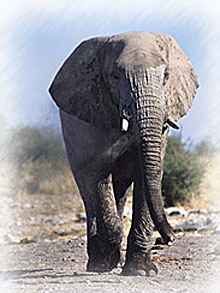
Elephants have fan-shaped ears that are up to 1.5 m (5 ft) long in the African genus, smaller in the Asian. The legs are massive and columnar, almost equally wide from top to bottom; the feet are broad and round. Both species have five toes on each forefoot, but the African elephant has three toes and the Asian elephant four toes (sometimes five) on each hind foot. The elephant's thick skin has sparse hair.
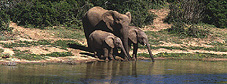
The African elephant is native to many parts of southern, central, and eastern Africa. It lives in forests, grasslands, river valleys, and deserts. Its numbers have been diminished by over hunting, mainly for the ivory of its tusks. Where it is protected, however, the African elephant tends to overpopulate and defoliate its range, resulting in starvation. The elephant uses its trunk to strip trees of branches and bark and even uproot them. A ban was placed on ivory trading in 1989 when the African elephant was declared endangered by the United Nation's Convention on International Trade in Endangered Species.
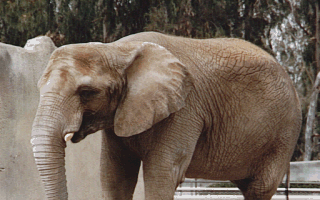
Asian elephants live in tropical grassy plains and rain forests. When the food supply is depleted, these elephants move in single file to more promising territory, which may turn out to be a cultivated plantation. Asian elephants are often captured and domesticated.
Elephants' bones lack marrow cavities; they are filled instead with a spongy material through which the marrow is distributed. Their grinding teeth are large and high, and usually only four teeth (excluding the tusks), one on each side of the upper and lower jaws, are present in the mouth at one time. Elephants eat only plant material, as much as 230 kg (500 lb) per day.